
For a heavy home safe, a bolting kit is only useful when its hardware matches the floor, the safe’s anchoring holes, and the installation plan. My two picks both target concrete floors, but they take different approaches: the Hornady Premium Safe Anchoring Kit is the more complete package, with a drill bit, socket, and leveling shims, while the Liberty Safe Heavy Duty Concrete Gun Safe Anchoring Kit is a simpler, lightweight option for a compatible Liberty safe and a straightforward concrete installation.
I rank Hornady first for buyers who want more installation components in one kit, especially if leveling is part of the job. Liberty earns my best brand-specific pick for a more basic anchoring setup with pre-drilled safe holes. Neither kit is a universal answer for every heavy safe or floor: both are described for concrete, and neither listing supplies enough information to confirm compatibility with every safe model, slab, or installation condition. My main tradeoff is all-in-one convenience versus a simpler kit; check the safe manual and the anchor specifications before drilling.
Key Takeaways
- Hornady is my overall pick when the included carbide drill bit, socket, washers, nuts, and polymer shims suit the planned concrete installation.
- Liberty is the simpler brand-specific choice for buyers with a compatible Liberty safe and existing confidence in their concrete anchoring process.
- Both kits are aimed at concrete; neither is presented as a solution for wood subfloors, tile-only surfaces, or other floor constructions.
- Hornady lists four 3/8-inch anchor bolts, but safe-hole fit and slab suitability still need to be checked against the safe maker’s instructions.
- Do not treat a kit alone as a capacity rating: anchor performance depends on the safe, fasteners, concrete, installation, and floor condition.
| Hornady Premium Safe Anchoring Kit, 95851 |  | Best Overall — most complete listed concrete installation package | Model: 95851 | Intended surface: Concrete floors | Anchor bolts: Four | VIEW ON AMAZON | See Our Full Breakdown |
| Liberty Safe Heavy Duty Concrete Gun Safe Anchoring Kit (10915) |  | Best Brand-Specific Pick — straightforward anchoring for compatible Liberty safes | Model: 10915 | Brand: Liberty Safe | Intended surface: Concrete flooring | VIEW ON AMAZON | See Our Full Breakdown |
| safe bolting kit for heavy home safe | Model | Intended surface | Anchor bolts | Diameter |
|---|---|---|---|---|
| Hornady Premium Safe Anchoring | 95851 | Concrete floors | Four | 0.38 inches |
| Liberty Safe Heavy Duty Concre | 10915 | Concrete flooring | — | — |
More Details on Our Top Picks
Hornady Premium Safe Anchoring Kit, 95851
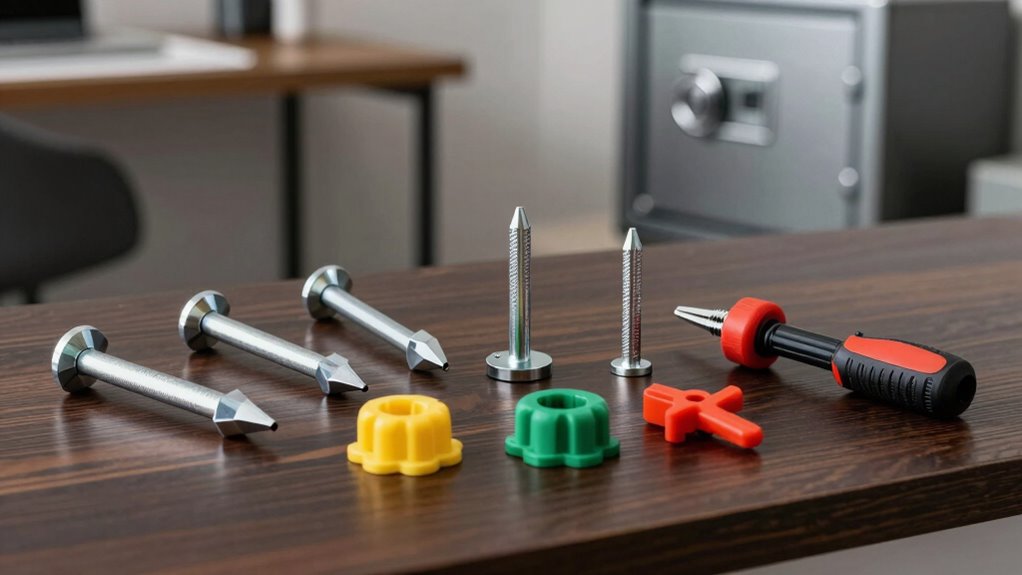
The Hornady kit takes my top spot because it gives buyers the clearest list of installation parts. Its package includes four concrete anchor bolts, nuts, washers, a carbide drill bit, a socket, polymer shims, and a dusting cloth. For someone planning a concrete-floor installation, that combination may prevent a few separate hardware and tool purchases and gives the kit a more ready-to-start feel than Liberty’s lighter, more basic listing.
The shims are a practical distinction, not decoration. A safe that rocks or sits unevenly can be awkward to load and use; shims give the installer a way to address placement as part of the setup. They do not compensate for an unsuitable floor or a poor anchor installation, though. The listing specifies a 3/8-inch diameter and 3/8-by-3/8-inch thread size, so I would check those against the safe’s mounting holes and the safe maker’s directions rather than assume the kit fits every model.
Compared with Liberty, Hornady is the stronger choice for buyers who want the listed drill bit, socket, and leveling pieces together. The tradeoff is that this package still requires drilling into concrete, which can be demanding for an inexperienced installer, and the supplied details do not state a safe-weight limit or concrete requirements. Its materials are described only as “Other,” so Liberty’s explicit alloy-steel specification is clearer. I would choose Hornady for component completeness, not because the listing proves a higher holding capacity.
Pros:- Includes four concrete anchor bolts with nuts and washers.
- Includes a carbide drill bit and socket to support installation.
- Polymer shims help address uneven safe placement.
- Lists a 3/8-inch bolt diameter for fit checking.
Cons:- Requires drilling into concrete, which may be difficult without suitable tools or experience.
- The supplied listing does not specify material composition, load capacity, or concrete requirements.
- Concrete-only use leaves it unsuitable for many wood-subfloor installations.
Best for: Homeowners anchoring a compatible safe to concrete who want bolts, shims, and basic drilling and socket accessories in one kit.
Not ideal for: Buyers with wood-framed floors, a safe whose holes do not match the listed 3/8-inch hardware, or anyone expecting a kit to remove the need for careful concrete drilling.
- Model:95851
- Intended surface:Concrete floors
- Anchor bolts:Four
- Diameter:0.38 inches
- Thread size:3/8 in x 3/8 in
- Included hardware:Nuts and washers
- Included accessories:Carbide drill bit, socket, polymer shims, dusting cloth
- Listed dimensions:8.5 x 5.3 x 1.5 inches
Our verdict“I would choose Hornady when its 3/8-inch hardware matches the safe and I want the most clearly itemized installation package of these two.”
Liberty Safe Heavy Duty Concrete Gun Safe Anchoring Kit (10915)
Liberty’s kit makes more sense for a buyer who wants a simple concrete anchoring option from the safe brand, rather than a bundle that includes several installation accessories. Its description says it works with pre-drilled holes, which can keep the mounting process direct when the safe and kit are a confirmed match. The listed alloy-steel construction also gives more material detail than Hornady’s “Other” entry.
That simplicity is also the limitation. The supplied specifications do not identify the number, diameter, or thread size of the fasteners, nor do they list a drill bit, socket, shims, or other included installation components. Hornady is easier to evaluate on those points because it names its bolt size and package contents. Liberty’s 7.2-ounce listed weight describes a light kit; it does not establish how much force the anchors can resist or prove that additional support is required. I would rely on the safe and kit instructions for those answers.
Compared with Hornady, Liberty is the more natural fit when the safe’s manufacturer documentation specifically calls for this kit or confirms its hole pattern. It is a less persuasive choice when a buyer needs dimensions before purchase or wants leveling shims and drilling accessories included. The supplied description confines its use to concrete flooring, and it lists no water-resistance feature. I would not extend that limitation into a performance judgment, but I would verify the actual environment and installation needs before selecting it.
Pros:- Designed for concrete anchoring with compatible pre-drilled safe holes.
- Uses alloy steel according to the supplied specification.
- Straightforward choice for a buyer following Liberty safe instructions.
- Lightweight package is easy to handle and store before installation.
Cons:- The supplied details do not list fastener count, diameter, or thread size.
- No drill bit, socket, or leveling shims are specified as included.
- Limited to concrete flooring in the supplied description.
Best for: Owners of a compatible Liberty safe who want a basic concrete-floor anchoring kit and can confirm the required fasteners from the safe documentation.
Not ideal for: Buyers who need a clearly specified bolt diameter, an all-in-one tool-and-shim package, or anchoring hardware for wood-framed floors.
- Model:10915
- Brand:Liberty Safe
- Intended surface:Concrete flooring
- Material:Alloy steel
- Item weight:7.2 ounces
- Color:Steel Grey
- Mounting type:Freestanding, tabletop
- Installation detail:Designed for pre-drilled holes
Our verdict“I would pick Liberty when the safe maker confirms compatibility and a basic concrete kit is preferable to Hornady’s more fully itemized package.”

How We Picked
I ranked these kits for one job: helping a buyer anchor a heavy home safe to concrete. That narrowed the comparison to the information provided about floor type, hardware, installation components, and compatibility. I gave Hornady the top position because its listing identifies four concrete anchor bolts and includes supporting items such as a carbide drill bit, socket, washers, nuts, and polymer shims. Those details give a buyer a clearer picture of what arrives and can reduce the need to source basic installation pieces separately.
Liberty ranks as the brand-specific, simpler option. Its stated advantages are pre-drilled-hole installation and alloy-steel construction, but the supplied information does not list a comparable bundle of tools or provide bolt dimensions. I did not treat “heavy duty,” “premium,” or general security claims as proof of a particular load capacity. Neither product description provides a tested safe-weight rating, concrete strength requirement, embedment depth, or confirmed universal fit.
I also weighed what could make either kit the wrong choice. Both are limited to concrete anchoring based on the supplied descriptions, so a wood-framed floor calls for a different plan and likely different hardware. Before choosing, I would compare the kit details with the safe manufacturer’s anchoring instructions, the safe’s hole pattern, and the actual floor assembly. The ranking reflects listed components and decision-making clarity, not hands-on testing or a claim that either kit fits every safe.
| safe bolting kit for heavy home safe | Intended surface |
|---|---|
| Hornady Premium Safe Anchoring | Concrete floors |
| Liberty Safe Heavy Duty Concre | Concrete flooring |
Factors to Consider When Choosing Safe Bolting Kit For Heavy Home Safes
A heavy safe calls for a matched installation, not just a kit with reassuring language on the label. I would make the floor and safe specifications the first filters, then compare what each package actually supplies.Start with the floor construction
Both options here are described for concrete floors. If the safe sits above a wood-framed floor, neither product should be treated as a ready-made solution: concrete anchors are made for a different substrate, and the safe maker may specify a different mounting method. Tile, laminate, or another finish also does not tell you what the structural layer beneath it is. Identify the actual floor assembly before choosing hardware, and seek appropriate professional guidance if you cannot confirm it.
Match the fasteners to the safe
Safe anchor holes, recommended fastener size, and installation directions vary by model. Hornady identifies 3/8-inch hardware, making it easier to compare with a manual or mounting diagram. Liberty’s supplied information does not list bolt dimensions, so a buyer should confirm those details with the safe documentation before purchase. A kit that cannot pass through the safe’s holes, or that conflicts with the manufacturer’s instructions, is not a good fit even if it is marketed for gun safes.
Judge the package by the installation job
Hornady lists bolts, nuts, washers, a carbide drill bit, a socket, shims, and a dusting cloth. That makes it the clearer pick if you want several basic pieces in one package, though it does not remove the need for a suitable drill, safe placement, or correct installation. Liberty lists a simpler kit and alloy-steel construction, but the supplied details do not confirm comparable tools or leveling parts. Check the contents you already own before treating either package as complete for your particular job.
Do not infer a weight rating from a product name
Neither listing supplies a tested holding capacity or safe-weight rating. Words such as “heavy duty” and “premium” are not substitutes for fastener specifications, slab requirements, and installation instructions. Safe mass is only one part of the anchoring question; the safe’s construction, hole layout, concrete condition, anchor placement, and installation all matter. If the maker specifies a particular anchor type or procedure, use that information rather than improvising from a general product description.
Plan for leveling and the drilling work
Hornady’s polymer shims are a useful difference if the safe needs adjustment to sit steadily, but shims do not make an unsuitable floor sound or correct a badly placed anchor. Concrete drilling also calls for the right tools, protective measures, and careful alignment with the safe’s holes and any hidden services. If you are uncertain about the slab or drilling safely, pause and get qualified help. Liberty may suit a more straightforward installation, but its supplied listing gives fewer details about included installation accessories.
Frequently Asked Questions
Which of these kits is better for a heavy home safe?
I rank Hornady first because its listing specifies four 3/8-inch concrete anchor bolts and includes a drill bit, socket, washers, nuts, and polymer shims. That makes the package easier to evaluate and may suit buyers who want basic installation accessories together. It is not a universal winner: the safe’s instructions and hole pattern must match, and the listing does not provide a safe-weight capacity. Liberty can be the better choice when its compatibility is confirmed for a specific Liberty safe.
Can either kit be installed on a wood floor?
The supplied descriptions identify both kits for concrete, so I would not select either as a wood-floor anchoring solution. A wood-framed floor needs hardware and an installation plan appropriate to that construction, with the safe maker’s instructions as the starting point. Surface finishes can hide the structural floor underneath, so confirm what the safe will actually be anchored to before buying or drilling.
Does the Hornady kit fit every safe with 3/8-inch holes?
No. The listed 3/8-inch diameter helps with a basic size comparison, but diameter alone does not confirm compatibility. Check the safe’s mounting-hole layout, thread and fastener requirements, clearances, and manufacturer instructions. The floor and concrete requirements also need to suit the anchor installation. I would confirm the complete fit rather than relying on a single dimension.
Does the Hornady kit’s inclusion of shims mean a safe will sit level?
Shims give an installer pieces for addressing some uneven placement, which is a useful advantage over a package that does not list them. They cannot correct every floor problem or replace proper anchor positioning and installation. Check the safe maker’s guidance on leveling and anchoring, and stop if the floor condition makes the safe unstable or the mounting points cannot be aligned correctly.
Should I hire someone to install a safe anchoring kit?
That depends on your tools, experience, safe instructions, and confidence identifying the floor construction. Both kits involve concrete anchoring, and the Hornady description specifically calls for drilling. If you cannot verify the slab, locate a safe drilling path, or follow the anchor directions, qualified installation help is a sensible choice. An included drill bit or socket does not replace knowledge of the floor or correct installation practice.
Conclusion
My choice is Hornady for buyers who want the more fully itemized concrete kit, especially when its 3/8-inch hardware matches the safe and the included shims and accessories suit the installation. I recommend Liberty for owners of a confirmed-compatible Liberty safe who prefer a simpler brand-specific option and can verify the fastener details before purchase. If your safe sits on a wood-framed floor, its holes do not match, or you cannot confirm the concrete and installation requirements, I would skip both until you have a compatible anchoring plan. The safest choice is the one that follows the safe maker’s directions and matches the actual floor—not the one with the broadest marketing claim.