
TL;DR

Get home office essentials delivered free with Prime
- Fast, free delivery on millions of items
- Prime Video, Amazon Music and more included
- Member-only deals all year
Robert Friedland told Mining Forum Americas that I-Pulse technology could replace conventional grinding mills, with the company projecting up to 80% lower energy use and about 5% higher metal recovery. Those figures are company projections; commercial-scale capacity, cost and independently verified comparisons have not been disclosed.
Robert Friedland, founder and executive co-chairman of Ivanhoe Mines, told Mining Forum Americas in Colorado Springs on Monday that technology developed by his private company, I-Pulse, could replace conventional grinding mills by fracturing ore with electrical pulses. I-Pulse projects the process could use up to 80% less energy and raise metal recoveries by about 5%, but it has not published commercial mine-scale results confirming those gains.
I-Pulse subsidiary I-ROX uses stored electricity released in pulses lasting from billionths to millionths of a second. The resulting shock waves pass through ore and fracture it from within. I-ROX says this can break rock preferentially along mineral boundaries, potentially exposing more valuable minerals while producing fewer ultrafine particles than conventional grinding. Friedland showed conference footage of copper ore passing through a test unit and breaking apart under electrical pulses.
“What we want to do is take away that SAG mill and that ball mill – bye-bye,” Friedland told the audience. He said the approach could mean substantial electricity savings and a lower carbon footprint. The figures of up to 80% lower energy use and roughly 5% higher recovery are I-Pulse projections, rather than independently verified results. Friedland did not disclose the results of tests using ore and tailings from Ivanhoe’s Kamoa-Kakula copper complex in the Democratic Republic of Congo.
I-ROX opened a 2,500-square-metre research centre in Toulouse, France, in January 2025, intended to support larger experiments and demonstrations. Ivanhoe has a financial stake in I-Pulse: in 2023, it converted a US$76-million loan to High Power Exploration into an equity stake in the company. The presentation did not establish when a full-scale processing unit could be deployed at a mine.
The Stakes for Mine Energy Use
Grinding is a major power demand at mines. A U.S. Department of Energy study identified it as the largest energy-consuming process in the U.S. mining industry. That finding describes industry-wide energy use; it does not quantify what a particular mine could save with I-ROX. If the company’s projections hold at industrial scale, lower power requirements could reduce operating costs and the generating capacity needed for new mines.
Higher recovery could also allow operators to produce more metal from the same volume of ore. That prospect matters as miners work deposits that are deeper, harder or lower grade, and as the industry faces concerns about future copper supply. The potential benefits remain conditional: companies would need evidence that the process works continuously, at the throughput mines require, and at a competitive cost. Friedland presented the technology as a way to recover more metal from material miners already handle, but gave no verified performance results to support a commercial comparison.
Top picks for "forum friedland want"
As an affiliate, we earn on qualifying purchases.
How I-ROX Targets Ore Fracture
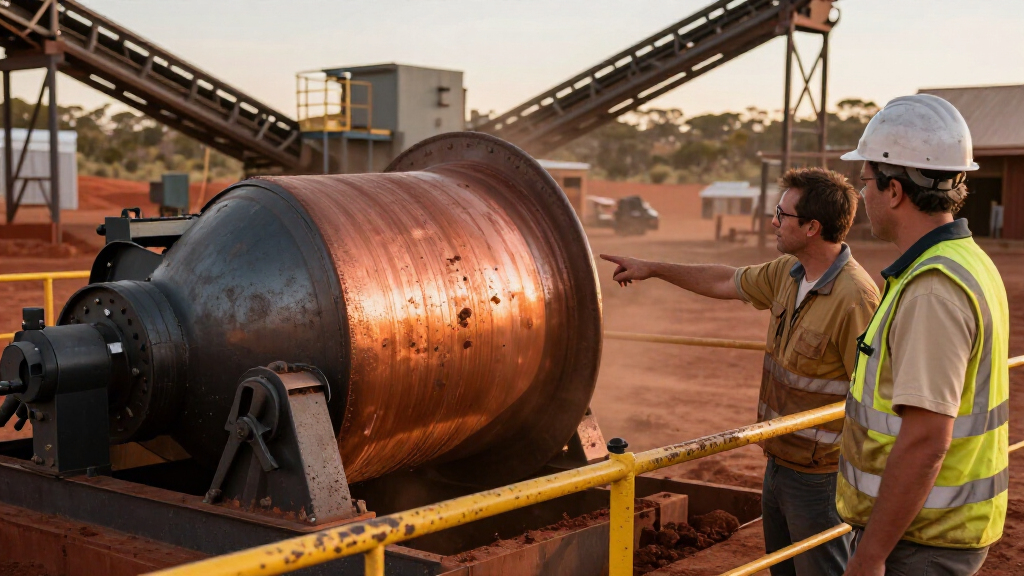
Most mines reduce ore through crushing and grinding. In a semi-autogenous grinding (SAG) mill, ore tumbles, sometimes with steel balls, before ball mills grind it further for mineral recovery. The process uses mechanical force on the outside of rock. I-ROX instead aims to send electrical pulses through ore so that shock waves fracture it from within. The company says breaks along mineral boundaries could make valuable material easier to recover.
I-Pulse is also developing G-Pulse, which uses the same pulsed-power platform to weaken hard rock ahead of a conventional drill bit. Friedland said it drills about three times faster and extends bit life sixfold; the company has not published independent results supporting those claims. Under a partnership for the Millungera Basin geothermal project in northwestern Queensland, I-Pulse is to take operational control and earn an initial 80% interest by investing at least $5 million. Its stake would become 65% when the joint venture is formed. Friedland said the technology used to crush and grind rock is also relevant to geothermal drilling.
I-Pulse separately secured a $250-million U.S. Department of Commerce award under the CHIPS Act to develop silicon-carbide semiconductors. The award and the company’s other activities provide background on I-Pulse, but do not establish that I-ROX can meet mine processing requirements.
““What we want to do is take away that SAG mill and that ball mill – bye-bye.””
— Robert Friedland, Ivanhoe Mines founder and executive co-chairman
Commercial Proof Still Missing
Key commercial details remain undisclosed. Friedland did not say what an industrial I-ROX or G-Pulse unit would cost, how much ore it could process, or when it might operate continuously at a mine. He also did not present an independently verified comparison between I-ROX and a conventional grinding circuit. The results of the Kamoa-Kakula ore and tailings tests were not shared during his keynote.
The company’s projected energy savings and recovery gains should not be read as demonstrated mine performance. It remains unclear whether the process can sustain the throughput and reliability required in continuous operations, or how its overall economics would compare with established mills. The source report also gives no project-specific baseline for measuring the claimed savings. The SAG mill therefore remains in use while I-ROX’s industrial performance is unproven.
Testing Before Mine Adoption
The next evidence to watch for is the publication of test results that compare I-ROX with conventional grinding and explain the ore type, processing conditions, energy measurement and recovery baseline. Larger experiments at the Toulouse research centre could help assess performance, but the report does not give a timetable for results or a commercial demonstration.
For G-Pulse, I-Pulse plans to validate the drilling technology at the Millungera Basin geothermal project. The partnership terms set out an initial investment and ownership arrangement, but the report does not identify a validation date or provide independent drilling data. Until more results are released, Friedland’s presentation describes a proposed alternative and company claims; it does not show that mines can yet retire their SAG and ball mills.
Key Questions
What technology does Friedland want to use instead of SAG mills?
He presented I-ROX, an I-Pulse subsidiary’s system that sends short electrical pulses through ore to fracture it from within. It is being developed as an alternative to conventional grinding.
How much energy could I-ROX save?
I-Pulse projects up to 80% lower energy use and about 5% higher metal recovery. These figures are company projections; the report says commercial mine-scale results have not been published.
Has I-ROX been proven at a commercial mine?
The report does not provide independently verified results from a commercial mine-scale installation. Ivanhoe sent ore and tailings from Kamoa-Kakula for testing, but Friedland did not disclose the results at the conference.
When could a mine replace its grinding mills?
No deployment date was given. The cost of an industrial unit, its processing capacity and its ability to operate continuously at a mine also remain undisclosed.
Source: rss
Halloween Picks
halloween
As an affiliate, we earn on qualifying purchases.