The “3-legged stool” of retirement—Social Security, pensions, and personal savings—forms your financial foundation for a stable retirement. Social Security provides about 58% of retiree income, especially for those earning less. Pensions offer steady, guaranteed payments for life, though they’re less common. Your personal savings, including IRAs and 401(k)s, fill in gaps and support your lifestyle. If you keep exploring, you’ll discover how to best balance these sources for a secure future.
Key Takeaways
- The “3-Legged Stool” refers to Social Security, pensions, and personal savings as the three main income sources for retirement.
- Social Security provides the primary income for over half of retirees, especially those with lower incomes.
- Pensions offer guaranteed lifetime payments but are declining in availability, increasing reliance on personal savings.
- Personal savings, including IRAs and 401(k)s, have grown significantly but vary widely among individuals.
- A balanced combination of all three sources ensures financial stability and resilience in retirement planning.
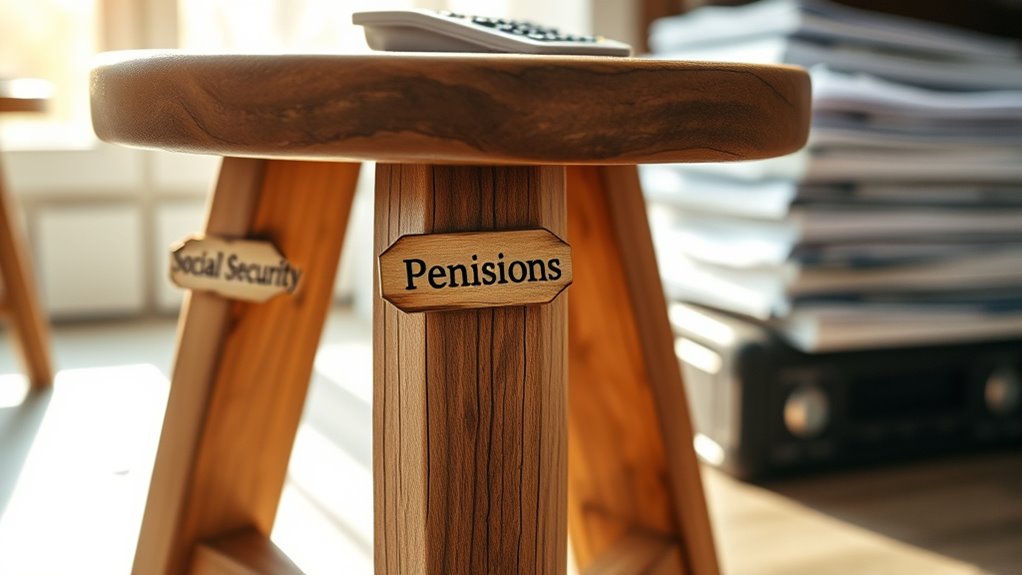
Retirement planning relies on a combination of Social Security, pensions, and personal savings, each playing a crucial role in ensuring financial stability. Social Security remains the cornerstone for most retirees, serving as the primary income source for about 58% of retirees. Over 87% of workers expect to depend on it, and nearly 78% of retirees actually receive benefits from Social Security. For many, especially those earning less than $50,000 annually or retired baby boomers, Social Security constitutes the main financial support during retirement. Women, in particular, tend to rely on Social Security more than men, with 82% depending on it versus 74%. It’s no surprise that nearly 80% of retired adults say they rely on Social Security, and over half of them feel “very” reliant on it for their expenses. This highlights its critical role in providing a safety net, especially given the uncertainties surrounding other income sources.
Social Security is the main income source for most retirees, especially those earning less than $50,000 annually.
Pensions and defined benefit plans add another layer of income, though their presence has declined over time. As of mid-2025, these plans hold around $12.3 trillion in assets, primarily in government and private-sector plans. While private pensions are less common today, they still form an important part of many retirees’ income streams. Only about 11% of current workers expect to rely on traditional pensions, but nearly 30% of retirees actually do. These pensions often work alongside Social Security to provide a more stable cash flow, especially since pension income can offer guaranteed monthly payments for life. However, funding challenges and accessibility issues threaten the future of defined benefit plans, making them less dependable as a consistent income source. In fact, the decline of traditional pensions has increased the importance of personal savings to fill the income gap. Additionally, many workers are increasingly turning to employer-sponsored retirement plans to supplement their income, emphasizing the shift towards individual savings strategies.
Personal savings and investments are the third critical component of retirement income. About 78% of workers and 64% of retirees expect personal savings to support them financially, underscoring their importance. Total retirement assets have surged to $45.8 trillion by mid-2025, with IRAs holding $18 trillion and 401(k)s $13 trillion. Despite these impressive figures, a significant number of workers remain unprepared—roughly 31% have no retirement savings, and most have less than $250,000 saved. The median household retirement savings sits around $65,000, far below what’s needed to sustain a comfortable retirement, especially considering rising healthcare costs and other expenses.
The income retirees actually receive varies widely, averaging around $60,000 annually, with married couples earning about $100,000. However, what’s sufficient depends heavily on your pre-retirement income and where you live. High-cost areas require more income to maintain your standard of living, and unexpected expenses like long-term care can quickly erode savings. Balancing these three pillars—Social Security, pensions, and personal savings—is essential to build a resilient retirement plan that can weather financial uncertainties and meet your lifestyle needs.

Letaya Metal Lateral File Cabinets with Lock,2 Drawer Steel Wide Filing Organization Storage Cabinets,Home Office Furniture for Hanging Files Letter/Legal/F4/A4 Size (Blcak-2 Drawer)
All-steel Stable-Rustproof:Lateral file cabinet is made of thick high-strength cold-rolled solid all-steel material.Rugged and not easily deformed, powder-coated...
As an affiliate, we earn on qualifying purchases.
Frequently Asked Questions
How Can I Maximize My Social Security Benefits?
To maximize your Social Security benefits, you should delay claiming until full retirement age or later. Keep working to increase your earnings, which boost your benefit amount. Check your earnings record regularly for accuracy. Consider working part-time after retirement to increase your benefits. Also, coordinate your claiming strategy with your spouse’s benefits if applicable. The longer you wait, the higher your monthly benefit will be.
What if My Pension Plan Is Underfunded?
About 40% of private-sector workers lack a pension plan, so if yours is underfunded, you need to act. You should consider increasing your savings, possibly through additional retirement accounts or investments. Also, explore other income sources like part-time work or annuities. Relying solely on an underfunded pension can be risky, so diversifying your retirement income guarantees you stay financially secure in your later years.
How Should I Balance Saving Between Early and Late Retirement?
You should prioritize saving early to take advantage of compound growth, even if it means cutting back later. Start as soon as possible, consistently contribute, and adjust your savings rate over time. As you get closer to retirement, increase your savings to guarantee a comfortable future. Balancing early and late savings helps you build a solid financial foundation, reducing stress and increasing your chances of a secure retirement.
Are There Tax Advantages to Different Retirement Savings Options?
Yes, there are tax advantages to different retirement savings options. Contributing to a traditional 401(k) or IRA can lower your taxable income now, giving you an immediate tax break. Roth accounts, on the other hand, let your investments grow tax-free, and withdrawals are tax-free in retirement. Choosing the right mix depends on your current income and future tax expectations, so consider consulting a financial advisor.
How Does Inflation Impact My Retirement Income Strategy?
Inflation can erode your retirement income’s purchasing power over time, so you need a strategy that outpaces it. You should consider investments like stocks or inflation-protected securities to help your savings grow faster than inflation. Also, plan for cost-of-living adjustments in Social Security and pensions. Regularly review and adjust your portfolio to guarantee your income keeps pace, so you can maintain your lifestyle throughout retirement.
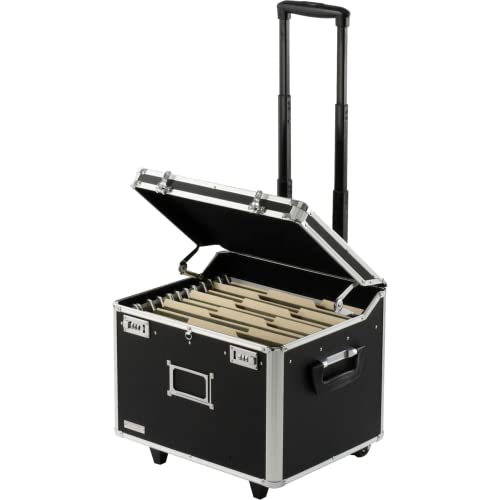
Vaultz Portable File Storage Box with Handle - 14.5" x 17.5" x 15.5" Letter/Legal Size Mobile Lock Box - Double Combination Locking Cabinet - Black
SIZE - Our locking mobile file box measuring 15 x 14 x 17 inches is ideal for locking...
As an affiliate, we earn on qualifying purchases.
Conclusion
To secure your retirement, remember that relying on just one leg isn’t enough—you need all three. Social Security, pensions, and savings work together like a well-balanced stool, keeping you steady in your later years. Don’t put all your eggs in one basket; diversify your resources to weather any storm. By staying proactive and planning ahead, you can guarantee your retirement years are comfortable and worry-free. Stay the course—your future self will thank you.

ENGPOW File Box with Lock,Fireproof Document Box with Zipper&Pockets,Collapsible File Organizer Filing Storage Cabinet with Handle,Portable Home Office Safe for Hanging Letter/Legal Folder,Black
Fireproof and water-resistant: Fireproof lock box is made of double layered non-itchy silicone coated fiberglass which stands up...
As an affiliate, we earn on qualifying purchases.

BYNSOE 2 Drawer File Cabinet with Lock Vertical Filing Storage Cabinet Office Home Steel Vertical File Cabinets for Letter Size File Cabinet Locked,Assembly Required
【HIGH CAPACITY】This filing cabinet consists of two drawers of the same size, which are large enough to accommodate...
As an affiliate, we earn on qualifying purchases.