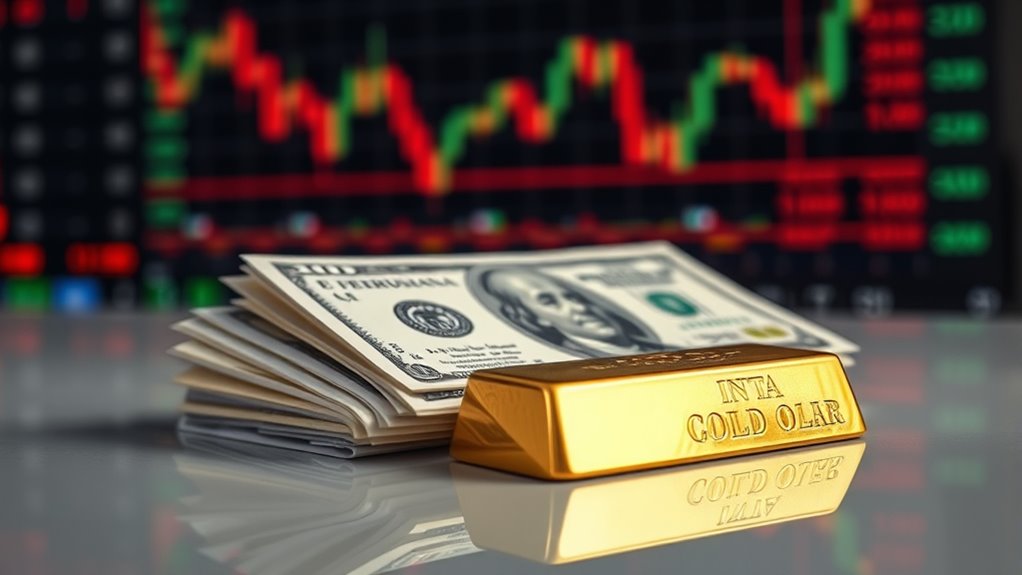

You can expect gold and the dollar to usually move in opposite directions, with gold rising when the dollar weakens and falling when it strengthens. However, during times of uncertainty or geopolitical crises, both can surge together as safe-haven assets. Stock market volatility often means gold prices go up when stocks decline. Because these relationships are influenced by many factors like inflation, interest rates, and global tensions, understanding them can help you navigate market changes more confidently. Keep exploring to see how these dynamics play out.
Key Takeaways
- Gold and the dollar typically move inversely, with gold rising when the dollar weakens.
- During economic or geopolitical crises, gold and the dollar can both increase as safe-haven assets.
- Rising interest rates tend to decrease gold’s attractiveness, strengthening the dollar’s influence on gold prices.
- Gold often declines when stocks rise, but both can surge simultaneously during periods of uncertainty.
- Central bank gold purchases and inflation expectations can disrupt typical correlations and impact gold’s behavior.
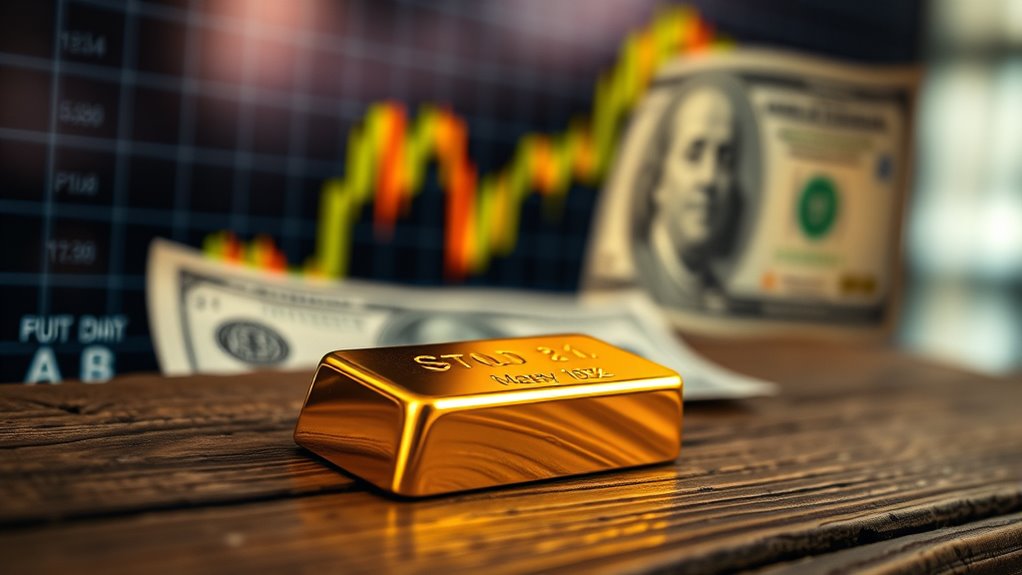
Gold’s relationship with the dollar and stocks is complex and often shifts based on economic and geopolitical factors. You’ll notice that, traditionally, gold and the U.S. dollar tend to move in opposite directions. When the dollar strengthens, gold prices usually fall because gold becomes more expensive for foreign buyers, reducing demand. Conversely, when the dollar weakens, gold often becomes more attractive, pushing prices higher. However, this inverse relationship isn’t absolute. During times of heightened uncertainty or crisis, both gold and the dollar can rise simultaneously, as investors seek safe havens. This dual surge can occur because both assets are viewed as reliable stores of value when the economy or geopolitical landscape is unstable.
Gold and the dollar often move inversely, but during crises, both can rise together as safe-haven assets.
Economic conditions play a significant role in this dynamic. For example, high inflation often boosts gold prices since investors see gold as a hedge against rising prices. Central banks’ actions also matter; when they buy gold, it can support prices regardless of the dollar’s strength. Additionally, the monetary policies set by central banks influence this relationship. When interest rates rise, non-yielding assets like gold tend to become less attractive, often leading to lower gold prices. Conversely, low interest rates or policies that promote inflation can make gold more appealing, even if the dollar remains strong. Monetary policy also impacts investor behavior and the attractiveness of gold as an alternative asset.
Geopolitical tensions further complicate the picture. During conflicts or global instability, investors flock to safe-haven assets, which can cause gold prices to climb despite a strong dollar. This demand is driven by the perception that gold offers security when economic or political stability is in question. On the other hand, stocks tend to react negatively during such times, as market volatility increases and economic outlooks become uncertain. Gold often acts as a hedge during stock market downturns, leading to a negative correlation between the two—when stocks fall, gold rises, and vice versa. This makes gold a valuable diversification tool in a portfolio, especially during turbulent times.
The impact of a strong dollar on gold isn’t always straightforward. While a robust dollar generally reduces gold’s appeal for foreign investors, geopolitical uncertainty and inflation concerns can still keep gold attractive. Central banks’ gold purchases can also counteract the downward pressure caused by a strong dollar, supporting prices even when the dollar is at its peak. Interestingly, central bank gold buying has reached historic levels, which can support gold prices even during periods of dollar strength. Overall, understanding these dynamics helps you anticipate how gold may behave in different economic scenarios, but remember that market conditions can change rapidly based on new geopolitical developments or shifts in monetary policy.

1986 – Present (Random Year) American Gold Eagle 1/10th oz Bullion Coin with Certificate of Authenticity $5 Seller Uncirculated
✔️Each coin contains 1/10 oz of gold.
As an affiliate, we earn on qualifying purchases.
As an affiliate, we earn on qualifying purchases.
Frequently Asked Questions
How Do Geopolitical Events Influence Gold’s Correlation With the Dollar?
Geopolitical events often cause you to see gold move independently of the dollar, as investors seek safe assets. When tensions rise, you’ll notice gold’s correlation with the dollar weaken because gold’s appeal increases due to uncertainty. Conversely, if events stabilize, gold may move more in sync with the dollar or stocks. These shifts depend on how investors perceive risk and their desire for stability during turbulent times.
What Role Do Inflation Rates Play in Gold’s Price Movements?
Inflation acts like a wildfire, fueling gold’s price by eroding the value of paper currencies. When inflation rises, you’ll see investors flock to gold as a safe haven, boosting its price. Conversely, when inflation cools, gold’s shine dims as cheaper alternatives emerge. You should watch inflation rates closely, because they’re the spark that can ignite or douse gold’s market flames, influencing whether it sparkles or sinks.
Can Gold Act as a Safe Haven During Stock Market Crashes?
Yes, gold can act as a safe haven during stock market crashes. When the markets tumble, investors often seek stability, and gold’s intrinsic value makes it a reliable asset. You may notice its price rising as confidence in stocks declines. Keep in mind, though, that gold isn’t foolproof, but historically, it provides a hedge against market turmoil and economic uncertainty.
How Do Interest Rate Changes Impact Gold and Dollar Relationships?
Imagine it’s the roaring twenties, and interest rate changes directly influence gold and the dollar. When rates rise, you’ll find gold less attractive since its non-yielding nature dims its appeal, while the dollar often gains strength. Conversely, lower rates make gold more enticing, and the dollar might weaken. You should watch central banks’ policies closely, as they shape the gold-dollar dance and your investment decisions.
What Are the Long-Term Trends in Gold’s Correlation With Stocks?
You’ll notice that long-term, gold’s correlation with stocks tends to fluctuate. During economic uncertainty or market downturns, gold often moves inversely, acting as a safe haven. However, in prolonged bullish markets, gold can sometimes trend with stocks. Keep an eye on economic conditions and investor sentiment, as these factors influence whether gold’s relationship with stocks remains negative, positive, or neutral over time.

IROLD 24k Gold Bar .9999 Fine with Assay Certificate – 1 OZ
Pure 24K: Crafted from .9999 fine gold for maximum purity and value.
As an affiliate, we earn on qualifying purchases.
As an affiliate, we earn on qualifying purchases.
Conclusion
As you navigate the twists and turns of gold’s dance with the dollar and stocks, remember it’s like a chameleon—shifting hues based on the economic landscape. Sometimes it shines brightest when others dim, acting as your financial compass. Keep your eyes peeled and your instincts sharp; gold’s relationship with the market is a wild yet fascinating ride. Trust your judgment, and let this precious metal be your guiding star through uncertain skies.

Investing in Gold: The Essential Safe Haven Investment for Every Portfolio
As an affiliate, we earn on qualifying purchases.
As an affiliate, we earn on qualifying purchases.

Fine Gold Price: Real-Time Spot Market Tracking, Interactive Financial Charts & Historical Data Export Tools for Global Precious Metals Investors, Wealth Managers and Professional Asset Enthusiasts
Real-Time Spot Precision: High-frequency, ultra-low latency gold price stream directly from major global exchanges.
As an affiliate, we earn on qualifying purchases.
As an affiliate, we earn on qualifying purchases.