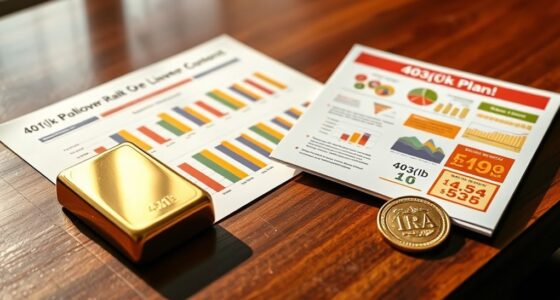

To hedge inflation in your IRA, consider combining TIPS, gold, and cash for balanced protection. TIPS adjust with inflation, safeguarding your fixed income. Gold acts as a store of wealth during inflation spikes and economic uncertainty. Cash offers liquidity but loses value over time, so limit its role. A diversified approach helps manage risks as inflation varies. Keep exploring these options to create a resilient retirement strategy that adapts to changing economic conditions.
Key Takeaways
- TIPS adjust principal and interest with CPI, providing direct inflation protection within your IRA.
- Gold acts as a tangible store of value, especially during inflation spikes and economic uncertainty.
- Cash offers liquidity but typically loses purchasing power during inflation, making it a weaker inflation hedge.
- Combining TIPS, gold, and cash diversifies your IRA, balancing inflation protection and risk management.
- As retirement nears, shifting toward safer, less volatile assets like TIPS and gold helps preserve real value.

Are you worried about inflation eroding your retirement savings? It’s a valid concern because inflation steadily reduces your purchasing power over time. To protect your IRA’s value, you need effective hedging strategies. These strategies aim to preserve your real returns, ideally keeping them within the 0% to 4% range, regardless of inflation swings. The key is understanding how different assets respond to inflation regimes. When inflation is volatile, real assets and inflation-linked securities tend to perform better, offering more stability. Diversification becomes essential, as spreading your investments across various asset classes reduces the risk of shortfalls during inflation spikes and helps smooth returns over different periods. As you approach or enter retirement, shifting toward safer, less volatile inflation hedges is typically advisable to protect your savings from market downturns.
Effective inflation hedges protect retirement savings and diversify assets for stable, real returns over time.
Treasury Inflation-Protected Securities (TIPS) are a popular choice for inflation hedging within IRAs. They adjust both principal and interest payments based on changes in the Consumer Price Index (CPI), directly safeguarding your purchasing power. Although the interest income from TIPS is federally taxable, it’s exempt from state and local taxes, which can boost your after-tax returns. TIPS generally offer lower yields compared to nominal bonds because of their inflation protection feature, but they serve as a reliable safeguard against inflation’s erosion. During periods of extreme market stress, liquidity issues might arise, but overall, TIPS remain a liquid and accessible option. They work well as part of your fixed-income allocation, especially in the post-retirement phase, where minimizing downside risk becomes a priority. Incorporating inflation-protected securities into your portfolio can provide essential stability during inflationary periods.
Gold offers another effective inflation hedge. Historically, gold retains or increases its value during inflationary periods and times of economic uncertainty. Unlike bonds or cash, gold doesn’t produce income like dividends or interest, which limits its total return potential. However, it’s valued as a store of wealth, especially when inflation exceeds 3%, providing diversification benefits that help stabilize your portfolio amid inflation spikes. Gold can be volatile, with prices often rising when governments expand their money supply or during economic troubles. Including a small proportion of gold in your IRA can help buffer your portfolio against inflation shocks, adding a tangible asset that tends to perform well in turbulent times.
Holding cash within your IRA might seem like a safe move, but it’s not an effective inflation hedge. Cash provides liquidity and capital preservation, yet during inflation, it loses real value because of low or negative real interest rates. While cash can serve as a buffer or an opportunistic rebalancing tool, over-reliance on it reduces your portfolio’s growth potential. It’s best reserved for short-term safety during periods of market volatility rather than as a primary inflation hedge. In low macro volatility regimes, holding some cash makes sense to balance risk, but it shouldn’t dominate your long-term strategy. Instead, consider a mix of assets that can effectively counteract inflation’s impact on your retirement savings.

Amazon Basics Steel Home Security Safe Box with Electronic Keypad Lock for Documents, Jewelry, Valuables, 1.8 Cubic Feet, Black, 13.8"W x 13"D x 19.7"H
PROTECTS VALUABLES: 1.8-cubic-foot home safe for safeguarding important documents, jewelry, cash, devices, and other precious items
As an affiliate, we earn on qualifying purchases.
Frequently Asked Questions
Can I Combine TIPS, Gold, and Cash in a Single IRA?
Yes, you can combine TIPS, gold, and cash in a single IRA. Diversifying your assets helps protect against inflation and market volatility. You can hold different investments within a self-directed IRA, giving you flexibility. Just make certain each investment complies with IRA rules and regulations. By blending these assets, you create a balanced approach that can better safeguard your retirement savings from inflation risks.
Are There Restrictions on Investing in Gold Within an IRA?
Yes, there are restrictions on investing in gold within an IRA. You can’t just buy any gold; it must meet specific purity standards, typically 99.5% or higher. The gold must be held by an approved custodian and stored in an IRS-approved depository. Personal storage isn’t allowed. Make sure to work with a reputable IRA custodian experienced in precious metals to guarantee compliance with all IRS rules.
How Does Inflation Impact Different IRA Assets Over Time?
Inflation erodes your IRA’s purchasing power over time, impacting assets differently. Cash loses value quickly, making it less ideal during inflation. TIPS adjust with inflation, helping your investment keep pace. Gold often retains value or appreciates, acting as a hedge. Your assets’ performance depends on inflation trends, so diversifying with inflation-protected securities, gold, and cash can help safeguard your long-term savings.
What Are the Tax Implications of Holding Gold in an IRA?
Holding gold in your IRA offers tax advantages, mainly that you won’t pay taxes on gains until you withdraw funds. If you use a self-directed IRA, gold stays tax-deferred, meaning your investments grow without annual taxes. When you eventually take distributions, you’ll pay ordinary income tax rates. Be aware that there are strict IRS rules about gold purity and storage, so verify your gold meets these standards to avoid penalties.
How Often Should I Rebalance My Inflation-Hedging IRA Portfolio?
Like a ship steering stormy seas, you should rebalance your inflation-hedging IRA portfolio at least annually. Regular checks guarantee your TIPS, gold, and cash allocations stay aligned with your goals, especially as market conditions shift. If you notice significant changes—say, a 10% swing—you might consider rebalancing sooner. Staying proactive helps protect your investments from inflation while keeping your risk level steady.

Sdstone Hanger Diversion Fireproof & Waterproof Safe with Lock & Small Fireproof Bag, Secret Safe for Money&Jewelry, Under Clothes with Hidden Compartment to Hide Items for Home or Travel Safe,2 Pack
【Three layers of fibrous material】:This Diversion Hanger Safe is made of three layers of fibrous material,Fireproof Silicone coated...
As an affiliate, we earn on qualifying purchases.
Conclusion
Think of your IRA as a garden, and inflation as a relentless weed threatening to choke out your growth. By choosing the right tools—be it tips, gold, or cash—you can safeguard your future harvest. Remember, each option is like a different seed, offering unique resilience. Stay vigilant and diversify; your financial landscape flourishes when you nurture it wisely. With careful tending, you’ll ensure your wealth blooms despite inflation’s persistent encroachment.

SentrySafe Shelf Safe with Digital Keypad Lock, Steel Safe with Interior Lining and Bolt Down Kit for Money, Jewelry, 0.78 Cubic Feet, 7.1 x 16.9 x 13.8 Inches, X075
Set your own digital combination with this medium-wide safe box; two override keys ensure you will always have...
As an affiliate, we earn on qualifying purchases.

SnapSafe Under Bed Safe, Large – Under Bed Gun Safe for Firearms, Ammunition and Valuables – Fits in Trunk of Small SUVs – Easy Access, Out of Sight, Space Saving – Black, 40 x 6 x 22 Inches
SnapSafe Under Bed Safe – Store valuable belongings out of sight while retaining easy access. Open the large...
As an affiliate, we earn on qualifying purchases.