
TL;DR
Anthropic’s $965 billion valuation and $65 billion raise aren’t just about money. They’re a calculated move to lock in compute capacity—chips, cloud, and infrastructure—that will fuel the next wave of AI growth. Revenue is surging, but the real game is about controlling AI’s backbone.
Forget about the headline: the real story in Anthropic’s latest move isn’t just a record-breaking valuation. It’s a shift in how AI giants think about growth. The $65 billion raised at a $965 billion valuation isn’t just an investment—it’s a massive infrastructure bet.
This is about chips, cloud capacity, and the hardware that powers the world’s most advanced AI models. Imagine pouring billions into the very backbone of AI development—because that’s exactly what Anthropic is doing. They’re telling us: the future of AI isn’t just about smarter models, it’s about bigger, faster, and more reliable compute.
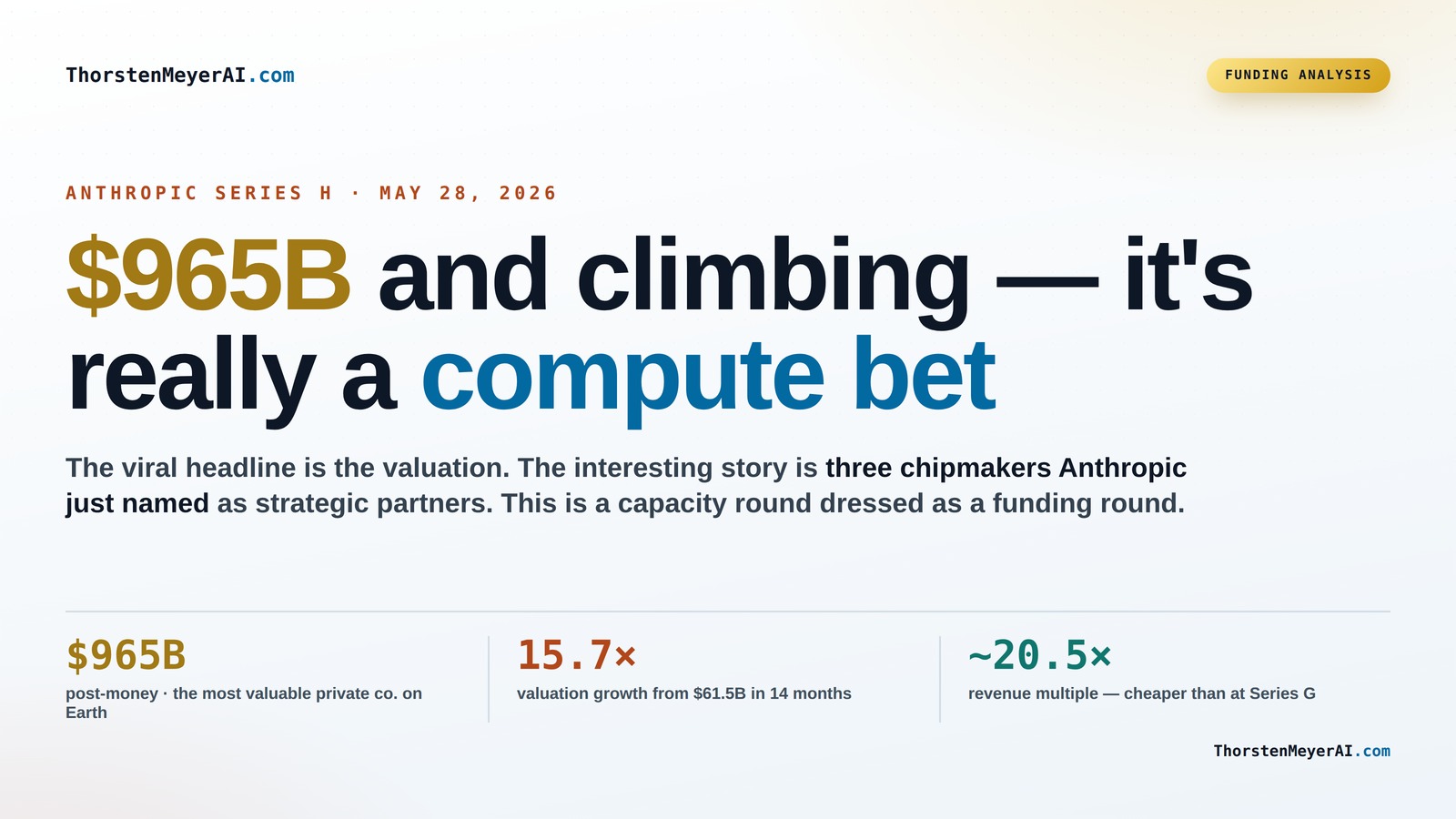
$965B and climbing — it’s really a compute bet
The viral headline is the valuation. The interesting story is in the press release’s middle paragraphs — and in three chipmakers Anthropic just named as strategic partners. This is a capacity round dressed as a funding round.
The numbers nobody can quite parse in sequence
Read together they describe a trajectory with no precedent in enterprise software. Read individually, each looks like a typo.
From $61.5B to $965B in fourteen months
Salesforce took roughly two decades to reach revenue numbers Anthropic just blew past. The sequence below is the part most coverage skips — it’s not the size, it’s the shape.
Anthropic’s valuation ladder · Mar 2025 → May 2026
Five rounds, fourteen months. Bar height is the valuation; the climb itself is the story. Tap any milestone for context.
The multiple actually got cheaper
Bubbles look like multiples expanding while revenue lags. Anthropic’s pattern is the inverse — the valuation tripled, but revenue grew faster, and the multiple compressed.
Revenue-to-valuation multiple · Series G → Series H
Same company, three months apart. The denominator (revenue) is outrunning the numerator (valuation) — exactly the opposite of what a bubble narrative predicts.
10+ gigawatts and three chipmakers
When you name Micron, Samsung & SK hynix alongside your equity backers, you’re saying the binding constraint isn’t demand or model quality — it’s the physical supply of memory chips. The Series H is a capacity round.
Compute commitments backing Anthropic’s capacity bet
$200B+ in announced compute spend across multi-year contracts. The $65B Series H raise has to be read against that bill, not against operating losses.
A genuinely durable bet — or a structural exposure?
Both readings can be true at once. The answer arrives over the next 18–24 months as the gigawatts come online and either fill with paying demand or don’t.
Revenue growth has no precedent in B2B software ($1B → $47B in 17 months). The multiple is compressing, not expanding. Claude is the only frontier model on all 3 major clouds. Enterprise AI spend share went from ~10% to >65% in a year. Compute commitments are tied to specific contracts with capacity dates.
20× revenue is not cheap by any historical software-investing standard. Revenue is reported gross of cloud-reseller pass-throughs, which inflates the top line. Profitability is 2 years out. Amodei’s own warning: a 12-month delay in AI progress “would make him bankrupt” — the compute commitments are a structural exposure to demand persistence.
The valuation race — and the IPO context
Anthropic shipped Opus 4.8 the same morning as Series H — not a coincidence. One week after OpenAI filed confidentially for IPO. The late-2026 frame is set: two frontier AI companies racing to public markets, each pitching durability.
Key Takeaways
- Anthropic’s valuation jump is driven by a focus on infrastructure capacity, not just revenue or product growth.
- The $65 billion raise is primarily committed to chips, cloud, and hardware—making it a ‘capacity round.’
- Massive investments in hardware partners and cloud capacity aim to eliminate bottlenecks for future AI scaling.
- Revenue growth is outpacing valuation multiples, indicating a real push toward infrastructure-led expansion.
- This signals a fundamental shift in AI funding—more about controlling the backbone than just developing models.
As an affiliate, we earn on qualifying purchases.
Why the $965B Valuation Is a Compute-Driven Milestone
Anthropic’s valuation surpassing a trillion dollars signals more than investor enthusiasm. It reflects a belief that the real bottleneck for AI growth is hardware—chips, memory, and cloud capacity—not just talent or data. This valuation is built on the idea that controlling compute capacity will unlock exponential AI progress.
For example, Anthropic’s recent revenue growth—jumping from $9B at the end of 2025 to over $47B in just a few months—proves demand is skyrocketing. But the key isn’t just the dollars; it’s the infrastructure needed to sustain this. Without enough chips or cloud power, these revenue numbers can’t keep climbing.
This round is less about what they’ve built now and more about what they plan to buy—more GPUs, memory modules, and cloud contracts—making it a ‘capacity round’ dressed as a funding event.
Practical takeaway: If you’re an AI startup or investor, understanding that infrastructure investments are now central means prioritizing hardware partnerships and supply chain resilience. For companies, consider how your growth depends on securing compute capacity—whether through cloud contracts or hardware alliances—and plan accordingly to avoid bottlenecks that could stall your progress.

cloud computing infrastructure for AI
As an affiliate, we earn on qualifying purchases.
As an affiliate, we earn on qualifying purchases.
How Much of the Money Is Actual Infrastructure Spending?
The $65 billion isn’t just for expanding AI models; most of it will go straight into hardware and cloud infrastructure. Reports indicate that over $15 billion of this round is pre-committed hyperscaler investments, including $5 billion from Amazon. That’s enough to buy thousands of high-end GPUs, storage systems, and networking gear.
Imagine a giant warehouse filled with shimmering servers, humming with power—each one a piece of the AI puzzle. This is where the real money flows. Tech giants like Micron, Samsung, and SK hynix are named as strategic hardware partners, signaling that supply chain control is now part of the game.
In practice, this means Anthropic is shaping itself into a buyer—effectively an industrial-scale AI infrastructure company—rather than just a software developer.
Practical takeaway: For decision-makers, this shift suggests that investing in or securing long-term hardware and cloud partnerships is crucial. Whether you’re building AI tools or deploying models, aligning with hardware suppliers or investing in your own infrastructure can provide a competitive edge and avoid costly delays caused by supply chain constraints.

As an affiliate, we earn on qualifying purchases.
The Revenue Surge: How It’s Changing the AI Landscape
Revenue growth at Anthropic is staggering—rising from under $10 billion at the end of 2025 to over $47 billion by May 2026. That’s a 5.4× jump in just four months. Even more striking, analysts project quarterly revenues of nearly $11 billion, surpassing previous annual totals. Learn more about industry growth trends.
For instance, a recent report states that Anthropic’s Q2 revenue will hit $10.9 billion—more than the entire 2025 revenue in just three months. This rapid growth signals a surging demand for AI services, driven by enterprise adoption and model training. But this isn’t just about selling AI; it’s about the infrastructure that powers these models.
Think of it like building a highway—more cars (or AI applications) mean you need a bigger, faster road. The revenue explosion is fueling, and being fueled by, the massive hardware investments.
Practical takeaway: If your organization is scaling AI services, recognize that revenue growth will increasingly depend on your ability to secure and optimize compute infrastructure. Investing in scalable cloud solutions, hardware partnerships, or even developing proprietary infrastructure could be key to maintaining competitive advantage and meeting demand.

As an affiliate, we earn on qualifying purchases.
Why This Is a Capacity Round, Not Just a Funding Round
In traditional startups, funding often goes toward product development or market expansion. Here, the focus is on acquiring infrastructure—chips, cloud time, data centers. The $65 billion is a strategic move to lock in capacity, ensuring they have enough hardware to sustain explosive growth.
It’s like investing in a power plant before demand skyrockets—anticipating future needs rather than just current ones. This approach reduces bottlenecks, makes scaling faster, and keeps competitors lagging behind.
For example, with over 10 gigawatts of compute commitments from partners, Anthropic is literally buying the power needed to train and run the world’s largest AI models.
Practical takeaway: For AI companies and investors, this indicates that securing long-term hardware and cloud commitments should be a priority. Building or partnering for scalable infrastructure can prevent future bottlenecks and ensure your growth trajectory remains uninterrupted.

The Hardware Ecosystem: Who’s Supplying the Chips?
Anthropic’s partners—Micron, Samsung, SK hynix—are key players in the global memory chip market. They’re supplying RAM, SSDs, and other critical components that keep AI models running smoothly and efficiently. The deal signals a shift: AI companies are becoming major buyers of hardware, influencing supply chains and pricing.
Imagine a bustling factory floor where each chip is a piece of a puzzle. When Anthropic commits billions to hardware, it affects the entire ecosystem, pushing chipmakers to ramp up production and innovate faster.
This dependence on hardware giants means Anthropic is betting on the supply chain’s stability—any hiccup could slow down their expansion.
Practical takeaway: For industry players, establishing strong relationships with hardware suppliers and understanding supply chain dynamics is vital. This proactive approach can help mitigate risks and ensure your infrastructure needs are met as demand accelerates.

What Does This Mean for the Future of AI? Bigger, Faster, More Reliable
This deal signals a new era—where AI growth hinges on infrastructure scale, not just algorithmic innovation. As Anthropic invests billions in chips and cloud capacity, it’s setting the stage for models that are bigger, faster, and more reliable than ever.
Think of it like upgrading from a city bus to a fleet of high-speed trains—more capacity, less delay. This infrastructure focus could accelerate AI’s integration into industries, from healthcare to finance, but it also raises questions about scalability and supply chain risks.
For example, if Anthropic’s infrastructure investments pay off, we might see AI models that process data in real-time, powering everything from autonomous vehicles to personalized medicine.
Practical takeaway: If you’re planning AI deployments, prioritize building scalable infrastructure and diversify your supply chain. This proactive approach can help you capitalize on the infrastructure-driven AI revolution and mitigate potential bottlenecks or delays.

Risks and Rewards: Is This a Bubble or a Strategic Shift?
Spending billions on hardware isn’t without risk. Supply chain disruptions, rising chip costs, and reliance on a few key suppliers could slow progress. Yet, the strategic value—controlling the backbone of AI—may outweigh these dangers.
It’s like building a dam—if it holds, the potential for water (or AI) to flow freely is enormous. But if the dam cracks, the risks are huge.
Ultimately, this move suggests a shift from pure software innovation to infrastructure dominance—an expensive, high-stakes game with the potential for massive rewards or serious pitfalls.
Practical takeaway: For industry leaders and investors, actively managing supply chain risks and diversifying hardware sources can be the difference between capitalizing on this trend or falling behind. Strategic infrastructure investments should be coupled with contingency planning to safeguard against disruptions.
Frequently Asked Questions
Why is this being called a compute round instead of a normal funding round?
This round is focused on acquiring hardware, cloud capacity, and infrastructure—think of it as buying the roads and bridges for AI. It’s less about revenue or product and more about ensuring enough compute power to fuel future growth.
How can Anthropic justify a $965B valuation?
The valuation reflects expectations about future AI growth driven by massive compute capacity. By controlling chips and cloud resources, Anthropic aims to dominate the infrastructure needed for the next wave of AI models.
What does it mean that the round includes $15B from hyperscalers?
This pre-committed investment from giants like Amazon signals a long-term partnership—buying hardware and cloud capacity at scale, which will be critical for Anthropic’s future AI training and deployment.
Is this a bubble or a strategic shift?
While risky, this infrastructure-centric approach signals a strategic shift—more focus on controlling the backbone of AI rather than just developing models. It’s a bold move that could reshape the industry or backfire if supply chains falter.
Conclusion
Anthropic’s latest move is a clear sign: the future of AI isn’t just about smarter models, but about bigger, faster, more reliable infrastructure. Control over compute capacity becomes the new strategic currency.
As AI continues to explode, expect more companies to follow suit—pouring billions into chips, memory, and cloud capacity. The question isn’t if we’ll need more compute; it’s how quickly we can build it.