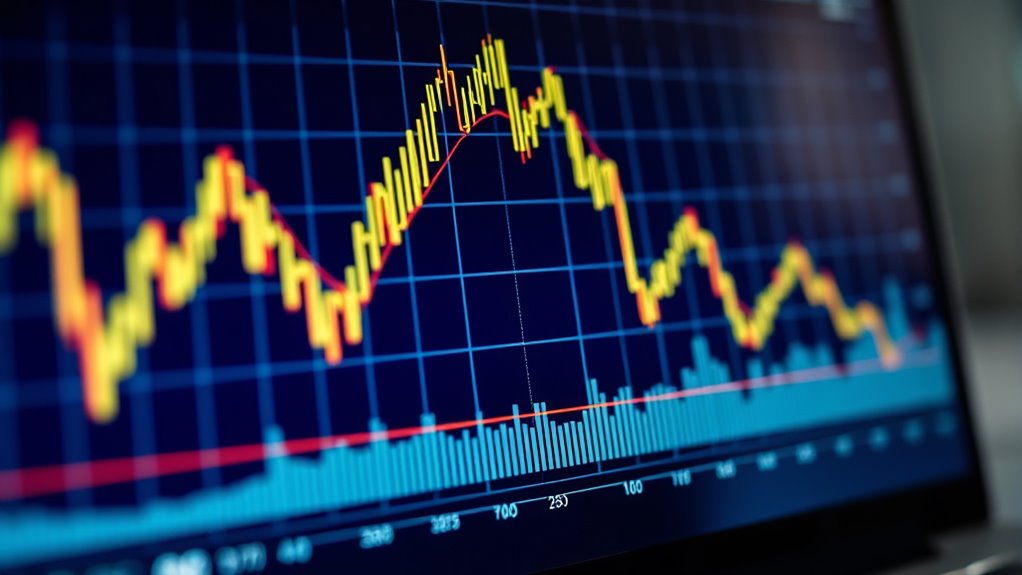

Yield curve inversions happen when short-term interest rates exceed long-term ones, which often signals an upcoming recession. While historically, every U.S. recession since the 1970s was preceded by an inversion, not every inversion leads to a downturn. They reflect investor expectations of economic slowdown but aren’t foolproof predictors. Market factors and policies also influence the curve. To understand how reliable this indicator really is and what influences it, there’s more to explore.
Key Takeaways
- An inverted yield curve occurs when short-term interest rates exceed long-term rates, often signaling potential recession risk.
- Historically, every U.S. recession since the 1970s has been preceded by a yield curve inversion.
- Inversions reflect investor expectations of future economic slowdown but do not cause recessions directly.
- Factors like central bank policies, low term premiums, and global uncertainties influence the yield curve’s shape and predictive power.
- Not all inversions lead to recessions, and modern monetary policies complicate the inversion’s reliability as a recession predictor.

Have you ever wondered what it means when short-term interest rates surpass long-term rates? This situation, known as an inverted yield curve, occurs when the yields on short-term bonds are higher than those on long-term bonds. Usually, long-term investments offer higher yields because they carry more risk and uncertainty over time. When this normal pattern flips, it signals that investors expect the economy to slow down or even enter a recession. Historically, inverted yield curves have been strong indicators of upcoming economic downturns, with most recent recessions in the U.S. being preceded by such inversions since the 1970s.
An inverted yield curve signals potential recession as short-term rates surpass long-term yields, warning of economic slowdown ahead.
Understanding the components of an inverted yield curve helps clarify why it signals trouble ahead. During an inversion, short-term interest rates are above long-term rates, which is contrary to normal market behavior. Several factors contribute to this, including low term premiums—the extra yield investors demand for longer-term investments—and expectations of future interest rate declines. When investors anticipate the economy weakening, they prefer to lock in longer-term bonds at current yields, driving their prices up and yields down, but if short-term rates are pushed higher by central bank policies or market conditions, the inversion occurs. Changes in risk premia and monetary policy actions, such as quantitative easing, also influence the slope of the yield curve, often making inversion more likely. Additionally, the low level of the term premium itself can make yield curve inversions more frequent and less predictive of recessions. Moreover, market expectations about future interest rate trajectories shape the yield curve’s slope, adding complexity to its interpretation.
Many see inverted yield curves as a reliable predictor of recessions. Since 1978, every U.S. recession was preceded by an inversion, making it a valuable, although not infallible, economic warning sign. However, not every inversion results in a recession; other economic factors can mitigate or delay downturns. While the inversion reflects investor expectations of slowing growth, it doesn’t directly cause a recession but tends to coincide with economic uncertainty. It’s essential to recognize that correlation doesn’t imply causation—just because the yield curve inverts doesn’t mean a recession is inevitable, but it does suggest that economic conditions are deteriorating.
Several factors influence the shape of the yield curve, including central bank policies, global economic events, government debt levels, and demographic shifts. These elements can amplify or diminish the likelihood of inversion and its predictive power. When the yield curve inverts, financial markets often react, prompting investors to adjust strategies. Bond prices fluctuate, and stock markets can become volatile, reflecting concerns about future growth. Investors also tighten risk management, preparing for potential downturns. Still, recent unconventional monetary policies and low term premiums have challenged the reliability of inversions as precise predictors, making it essential to consider multiple economic signals rather than relying solely on the yield curve. In addition, global economic uncertainties and monetary policy responses can influence the yield curve’s behavior, complicating its interpretation as a recession predictor.
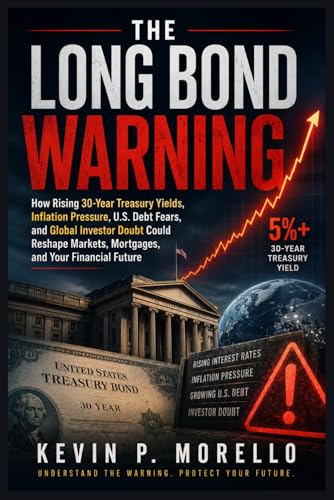
The Long Bond Warning: How Rising 30-Year Treasury Yields, Inflation Pressure, U.S. Debt Fears, and Global Investor Doubt Could Reshape Markets, Mortgages, and Your Financial Future
As an affiliate, we earn on qualifying purchases.
As an affiliate, we earn on qualifying purchases.
Frequently Asked Questions
How Reliable Are Yield Curve Inversions as Recession Indicators?
Yield curve inversions are generally reliable indicators of upcoming recessions, but they’re not foolproof. When you see short-term rates exceed long-term rates, it often signals economic trouble ahead. However, some inversions don’t lead to recessions, and others are followed by delays. So, while useful, you should consider them alongside other economic data to get a clearer picture of potential downturns.
Can Yield Curve Inversions Predict the Timing of a Recession?
Think of yield curve inversions as a weather forecast for the economy—sometimes it hints at a storm, but not always. While they can signal a recession is on the horizon, they don’t tell you exactly when it’ll hit. You should watch for other signs too, like slowing growth or rising unemployment. Relying solely on yield curve inversions is like trusting one cloud to predict the entire weather—wise, but not foolproof.
Do All Yield Curve Inversions Lead to Recessions?
Not all yield curve inversions lead to recessions. While an inversion often signals economic uncertainty or a potential slowdown, it doesn’t guarantee a recession will happen. Sometimes, external factors or policy responses can prevent a downturn. As an investor or observer, you should consider other economic indicators alongside yield curve movements to get a clearer picture of the overall economic outlook. Stay vigilant, but don’t assume an inversion alone predicts a recession.
How Do Global Economic Factors Influence Yield Curve Inversions?
Global economic factors profoundly influence yield curve inversions by shaping investor expectations and monetary policies. When global growth slows or geopolitical tensions rise, investors seek safer assets like long-term bonds, causing yields to fall and inversion signals to appear. Conversely, strong international growth or stable geopolitics can stabilize yields, preventing inversions. You should monitor global events and economic indicators, as they directly impact the bond market and yield curve behavior.
What Are the Limitations of Using Yield Curves for Economic Forecasting?
You should know that yield curves have limitations in forecasting the economy. For example, a recent inversion didn’t lead to a recession, so relying solely on this indicator can be misleading. Market interventions, central bank policies, and global events can distort signals. Hence, you should use yield curves alongside other data, like employment and inflation trends, to make more accurate economic predictions.

Money Market Investing 101: A Beginner's Guide to Low-Risk Short-Term Investments (Safe Income Investing Mastery)
As an affiliate, we earn on qualifying purchases.
As an affiliate, we earn on qualifying purchases.
Conclusion
As you watch the yield curve dip into inversion, it’s like seeing a dark cloud gathering on the horizon—calm now, but signaling an approaching storm. While it’s not a guarantee, the inversion acts as a subtle warning, urging you to pay attention to the shifting winds of the economy. Keep your eyes open, for just beyond the horizon, the shadow of a recession might be quietly taking shape, waiting to unfold.

Timing the Market: How to Profit in the Stock Market Using the Yield Curve, Technical Analysis, and Cultural Indicators
As an affiliate, we earn on qualifying purchases.
As an affiliate, we earn on qualifying purchases.

MilesMagic Magician's Prediction Book Gimmick | Mind Reading Flip Book Revelation | Real Choice Revealing Close Up Mentalism Street or Stage Magic Trick (V2)
The magician shows a paperback book, on the front of which is printed a picture of a pen,…
As an affiliate, we earn on qualifying purchases.
As an affiliate, we earn on qualifying purchases.